No Artist - Stereo-Monophonic Test Record #1 album flac
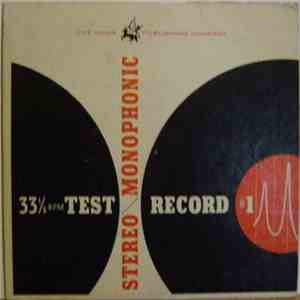 Performer: No Artist
Title: Stereo-Monophonic Test Record #1
Style: Technical
Country: US
MP3 album: 1264 mb
FLAC album: 1533 mb
Rating: 4.7
Other formats: MP2 APE AHX AAC MP3 MMF VOX
Genre: Not albums
Catalog number on sleeve: HFS69 Catalog number on labels: HF S69. Information on sleeve: Music excerpt, Side 1, Test 5: From Pye TPLS13005.
FCP is happier with stereo interleved files than 2 mono L and R files. When you import stereo interleved it drops the audio on 2 tracks and sets L and R correctly.
The AUDIO ALBUM STEREO TEST RECORD 7'' FLEXIDISC Brian Henderson AUSTRALIA Flexi. LAFAYETTE HI-FI STEREO-MONO TEST RECORD lp & insert 1959 audiophile NY radio VG+. EUR 3. 1. New listing SDD1- EMI Stereophonic Recording Demonstration Test Record Audiophile Stereo LP. EUR 1. 5.
Monophonic is an antonym of stereo. As adjectives the difference between monophonic and stereo. is that monophonic is (of sound reproduction) having a single channel; monaural (compare stereophonic) while stereo is of sound, music, etc, recorded in stereo.
Monaural or monophonic sound reproduction (often shortened to mono) is sound intended to be heard as if it were emanating from one position. This contrasts with stereophonic sound or stereo, which uses two separate audio channels to reproduce sound from two microphones on the right and left side, which is reproduced with two separate loudspeakers to give a sense of the direction of sound sources. Monaural recordings, like stereo ones, typically use multiple microphones fed into multiple channels on a recording console, but each channel is "panned" to the center. In the final stage, the various center-panned signal paths are usually mixed down to two identical tracks, which, because they are identical, are perceived upon playback as representing a single unified signal at a single place in the soundstage.
Stereo disc recording. There are two possibilities to modulate a groove: Simplified presentation. amp; Horizontal Modulation. Both modulations together: Two Channels Maximum Stereo or Mono and 1 channel 180° phased.
Monophonic synth users feel the same way about their instruments of choice. To this end, a monophonic synth is actually designed differently from a polyphonic one. A monophonic synth allows the sound designer to a create a extremely large tone, seeing as it only has one note to be responsible for at a time. Polyphonic instruments, however, are capable of producing many different notes at once, and therefore have to be designed with a slightly thinner sound in mind, so as not to overwhelm the senses, or sound too muddy to the listener.
Tracklist
| Stereo Only - 45/45 Cut | |
| A1 | Channel Identification |
| A2 | Stereo Balance |
| A3 | Speaker Phasing |
| A4 | Rumble Test (Tones Of -20 DB, -30 DB, -40 DB, -50 DB, And Quiet Grooves) |
| Stereo Or Monophonic - Lateral Cut | |
| B1 | Stylus Wear, 1000 CPS, 7 CM/Sec. (Compare With Band 3) |
| B2 | RIAA Equalization - 15,000 To 40 CPS |
| B3 | Same As Band 1 |
Companies, etc.
- Published By – Ziff-Davis Publishing Company
Notes
Cut by Hydrofeed ®Barcode and Other Identifiers
- Matrix / Runout (A-Side Runout Etching): CC 1170
- Matrix / Runout (B-Side Runout Etching): CC 1175
Other versions
| Category | Artist | Title (Format) | Label | Category | Country | Year |
|---|---|---|---|---|---|---|
| none | No Artist | Stereo-Monophonic Test Record #1 (7") | HiFi / Stereo Review | none | US | Unknown |
| none | No Artist | Stereo-Monophonic Test Record #1 (7") | Electronics World | none | US | Unknown |
| none | No Artist | Stereo-Monophonic Test Record #1 (7", Promo) | Electronics World | none | US | 1959 |

Unknown Artist - The Wonderful World Of Stereo download flac