Eugene Ormandy - Symphony No. III (William Schuman) album flac
 Performer: Eugene Ormandy
Title: Symphony No. III (William Schuman)
Released: 1951
MP3 album: 1349 mb
FLAC album: 1917 mb
Rating: 4.4
Other formats: MPC AC3 MP4 AA ADX MIDI TTA
Genre: Classical
Complete your Philadelphia Orchestra, Eugene Ormandy collection. Symphony No 3 ("The Camp Meeting"). 1. Old Folks Gatherin'. 2. Children's Day. 7:30. New England Triptych. Be Glad Then, America.
Symphony No 3 ("The Camp Meeting"). A1. – 1. Conductor – Eugene Ormandy. Engineer – Edwin Begley. Orchestra – The Philadelphia Orchestra.
Allegro moderato - Eugene Ormandy. Открывайте новую музыку каждый день. Лента с персональными рекомендациями и музыкальными новинками, радио, подборки на любой вкус, удобное управление своей коллекцией. Миллионы композиций бесплатно и в хорошем качестве. Eugene Ormandy, Johann Sebastian Bach, The Philadelphia Orchestra, Sir William Walton. Sinfonia for Double Orchestra in E-Flat Major, Op. 18, No. 1: III. Allegro. Eugene Ormandy, Johann Christian Bach, The Philadelphia Orchestra.
Eugene Ormandy (born Jenő Blau; November 18, 1899 – March 12, 1985) was a Hungarian-American conductor and violinist, best known for his association with the Philadelphia Orchestra, as its music director. The maestro's 44-year association with the orchestra is one of the longest enjoyed by any conductor with a single orchestra. Under his baton, the Philadelphia Orchestra had three gold records and won two Grammy Awards.
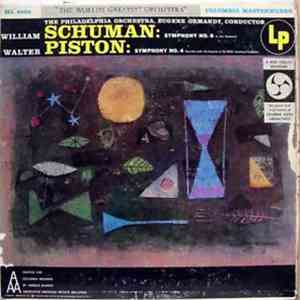
Yes, Eugene Ormandy and the Philadelphia Orchestra did commission, premiere, and record many of the Great American Symphonists. In this re-packaging of William Schuman's Symphony No. 6, Walter Piston's Symphony No. 4, and Roy Harris' Symphony No. 7, Ormandy's conducting seems perfunctory and his involvement seems minimal, the Philadelphia's playing seems uninvolved and rushed, and Columbia's late-'50s sound is serviceable but not much more.
This was originally release as an LP prior to High Fidelity, but it is still a great performance with a great sound. With the 6th Symphony, Schuman's music began turning inwards - and the extrovert works of the 1940s became transformed into the dark, brooding, dramatic essays of the remaining 35 years of his career. In one long movement, it favors Schuman's variation procedures (a sort of gigantic passacaglia) framed in what could be called the George Washington Bridge structure.
Tracklist
| A1 | First Movement: Passacaglia |
| A2 | Second Movement: Fugue |
| B1 | Third Movement: Chorale |
| B2 | Fourth Movement: Toccata |