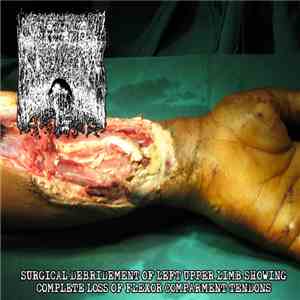
MxOxPxCxBxIxTxIxLxOxTxBxVx - Surgical Debridement Of Left Upper Limb Showing Complete Loss Of Flexor Comparment Tendons album flac
 Performer: MxOxPxCxBxIxTxIxLxOxTxBxVx
Title: Surgical Debridement Of Left Upper Limb Showing Complete Loss Of Flexor Comparment Tendons
Style: Grindcore, Noise
MP3 album: 1216 mb
FLAC album: 1569 mb
Rating: 4.2
Other formats: DMF FLAC XM AA VQF AIFF TTA
Genre: Rock
TxBxVx – Surgical Debridement Of Left Upper Limb Showing Complete Loss Of Flexor Comparment Tendons.
Debridement is the medical removal of dead, damaged, or infected tissue to improve the healing potential of the remaining healthy tissue. Removal may be surgical, mechanical, chemical, autolytic (self-digestion), and by maggot therapy. In oral hygiene and dentistry, debridement refers to the removal of plaque and calculus (tartar) that have accumulated on the teeth
The flexor and residual extensor tendons were repaired using, respectively, and. nylon and a neurorraphy of the median nerve was carried out with 8/0 nylon under microscope magnification. The surgical treatment of severe infections following trauma of the upper limb frequently leaves important defects that require complex reconstructive procedures. Traditional concepts of wound treatment include multiple debridements followed by a long period of topical wound care, frequently supported by Vacuum-Assisted Closure, before proceeding with flap reconstruction. However the evolution of microsurgical techniques by using free tissue transfert has facilitated a one-stage reconstruction of these complex defects
2-Tenderness along anterior edge of acromian process 3- Loss of motion : Prolonged capsulitis.
Surgical debridement is the removal of unhealthy or dead tissue from a wound to allow for faster healing or to prevent infection; the surgeon may also remove bone or fluid from the area. This method of debridement is only used for large or deep wounds or in urgent situations in which the tissue must be removed immediately. Most types of debridement take two to six weeks to complete, but because doctors can directly remove specific tissue when performing surgical debridement, hospital stays and recovery times are typically faster with this method. Ad. Debridement procedures are used to treat skin injuries and burns or conditions caused by other diseases, such as bed sores or ulcers.
Upper Limb Infections in ESRF Patients-Germaine G Xu et al. Epidemiology and Management of Surgical Upper Limb Infections in Patients. with End-stage Renal Failure. Eight patients were unfi t for further surgery, and left to. heal by secondary intention. Twelve patients (25%) experienced life-threatening events. hand and upper limb involves aggressive and complete. surgical debridement of all tissues of questionable viability; using antibiotics, rest and elevation as an adjunct.
Surgical debridement (also known as sharp debridement) uses a scalpel, scissors, or other instrument to cut necrotic tissue from a wound. It is the quickest and most efficient method of debridement. When the dressing is removed, the dead tissue is pulled away too. This process is one of the oldest methods of debridement. It can be very painful because the dressing can adhere to living as well as nonliving tissue. Because mechanical debridement cannot select between good and bad tissue, it is an unacceptable debridement method for clean wounds where a new layer of healing cells is already developing. Chemical debridement.
Tracklist
| 1 | All Traxx Untitled |